Critical Thinking and Literary Analysis
Critical thinking is not simply the ability to question, it is the discipline of questioning well. It requires moving beyond instinct, assumption, and surface interpretation to engage with ideas through reason, structure, and evidence. In literary analysis, this means examining not only what a text says, but how it says it, why it says it, and what it ultimately suggests about human experience.
Philosophers have long shaped the foundations of critical thought. René Descartes emphasized systematic doubt, urging us to question everything in pursuit of certainty. David Hume challenged assumptions about cause and effect, reminding us that belief is often shaped by habit rather than reason. Friedrich Nietzsche extended this further, questioning accepted truths and encouraging the dismantling of inherited values.

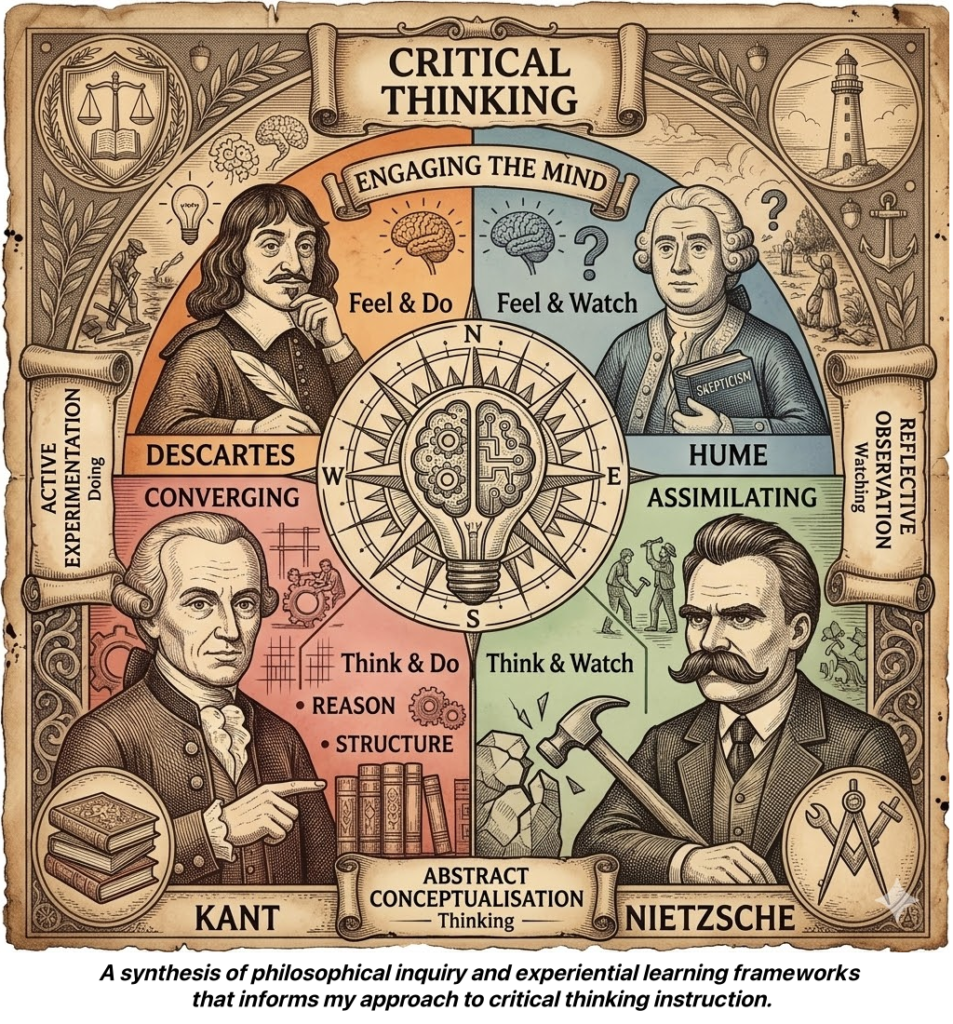
At the center of this intellectual tradition stands Immanuel Kant, whose work bridges reason and ethics. His concept of the Categorical Imperative asks us to evaluate actions based on whether they could be universally applied: Would it be acceptable if everyone acted this way? In literary analysis, this principle becomes a powerful tool. It encourages students to examine characters’ decisions not only within the context of the story, but against broader moral frameworks. Are their actions justifiable? Are they consistent? Do they reveal something universal about human behavior?
To think critically, then, is to engage actively with texts—to test ideas, challenge assumptions, and seek coherence. It is not about finding a single “correct” interpretation, but about constructing reasoned, evidence-based arguments. In doing so, students develop not only stronger analytical skills, but a deeper understanding of literature as a reflection of complex human thought.

← Grow and apply critical thinking skills through debate and rhetoric. Click the image to find out more.
Watership Down Novel Study
Click the image above to vist that page.
This module is designed to move students from foundational comprehension toward meaningful literary and ethical analysis through structured scaffolding. Using Watership Down as a central text, students build vocabulary and narrative understanding before engaging with deeper questions of leadership, responsibility, and moral decision-making.
The unit culminates in a first-person narrative assessment in which students write from the perspective of a new rabbit in the Sandleford warren, recounting key events from the novel. This task requires students not only to demonstrate textual knowledge, but to interpret character motivations and justify actions within the story’s moral framework.
Students apply principles aligned with Kant’s Categorical Imperative, evaluating whether actions—such as Hazel’s leadership decisions—could be considered universally justifiable. By combining narrative writing with ethical reflection, the module develops both analytical precision and the ability to engage with literature as a space for complex human judgment.
Students demonstrate this learning by constructing evidence-based interpretations of character decisions, justifying their reasoning through both textual analysis and ethical evaluation.
Discover more on my novel studies page→