Education Blog: Essays and reflections on literacy, rhetoric, and critical inquiry
Culturally Responsive Teaching
By Darren Carter, M.Ed. | English & Rhetoric Specialist
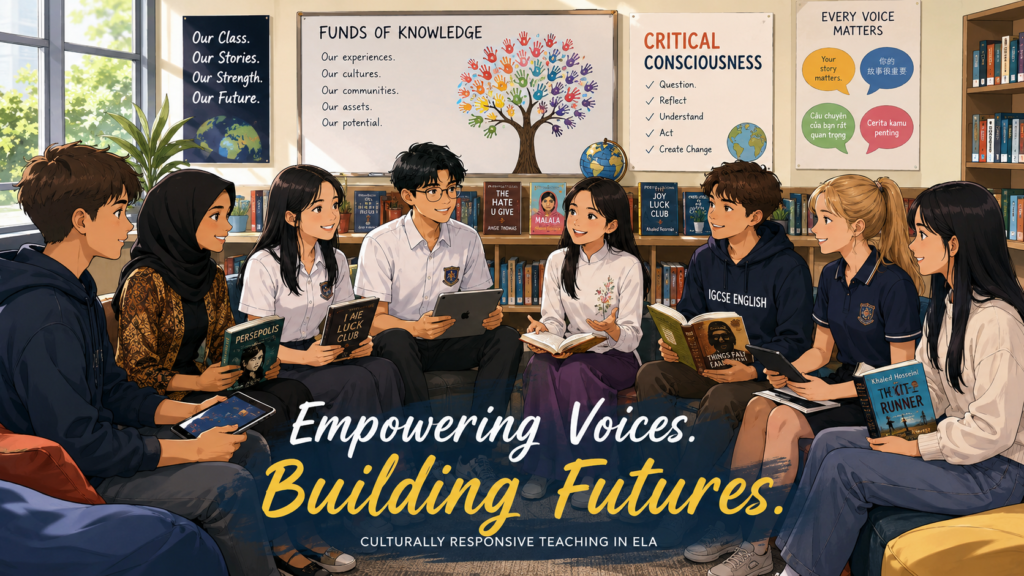
Culturally Responsive Teaching goes far beyond adding a few diverse books to the reading list or celebrating holidays from different cultures. I see it as a commitment to understanding that each student’s language, identity, background knowledge, and lived experiences profoundly shape how they connect with literature, writing, and discussion. Having taught in Taiwan, Vietnam, and Indonesia, I’ve seen firsthand that culturally responsive teaching isn’t optional in international schools—it’s essential if we want learning to be meaningful. In my current classes, students come from a wide range of linguistic and cultural backgrounds. They arrive with different levels of English proficiency, unique literacy experiences, varying degrees of confidence, and their own ways of communicating.
One of the most powerful ideas I’ve worked with is “funds of knowledge.” Instead of seeing cultural or linguistic differences as problems, this approach encourages us to recognize the rich experiences, skills, and knowledge students bring from their homes and communities (Washington Office of Superintendent of Public Instruction, 2023). I see this every day in my classroom. Some students who struggle with academic English are incredibly strong oral storytellers or persuasive speakers. Others come from systems that focused heavily on memorization, so they feel nervous participating in open discussions or debates. When students see themselves reflected in the texts and topics we study, they engage much more deeply. I’ve noticed this clearly in writing lessons. When I let students set their narrative stories in Jakarta, Taipei, or their hometowns instead of forcing a generic Western setting, the writing becomes noticeably more authentic and energetic. The same happens in persuasive writing and debates when we connect topics to issues that matter in their own lives and cultures. Gloria Ladson-Billings’ framework of Culturally Relevant Teaching, academic success, cultural competence, and critical consciousness has been especially helpful (Ladson-Billings, 1995). In diverse classrooms like mine, it reminds me that language learning is closely tied to identity. Differentiation isn’t just making things easier. It is about understanding how culture and previous schooling shape the process by which students learn, then scaffolding accordingly while keeping expectations high.
For me personally, because of my pastoral counseling background, I am aware of how important psychological safety is. Students who feel their experiences are valued are far more willing to take risks, speak up, and think critically than those who worry about being ignored or even criticized. The classroom isn’t insular, but it should provide a buffer from criticism, even from peers outside of class. Culturally sustaining pedagogy takes this even further. It’s not enough to just acknowledge differences; we should actively support and sustain students’ languages, cultures, and identities. This feels especially important in international schools, where many students are balancing multiple cultural worlds at once. Routines, organization, and academic supports matter, but we should emphasize that every classroom procedure sends a message about whose voices are valued. I do a lot in terms of relationship building already, but we should build in more intentional relationship-building, more student choice and voice, all while maintaining high standards. At the end of the day, culturally responsive teaching is about making sure every student, not just those already confident with academic English, feels capable of participating confidently, thinking critically, and succeeding academically.
References
Education Week. (2021). What is culturally responsive teaching?
https://www.edweek.org/leadership/what-is-culturally-responsive-teaching/2021/05
Ladson-Billings, G. (1995). Toward a theory of culturally relevant pedagogy. American Educational Research Journal, 32(3), 465–491.
https://doi.org/10.3102/00028312032003465
Washington Office of Superintendent of Public Instruction. (2023). Funds of knowledge toolkit.
https://ospi.k12.wa.us/sites/default/files/2023-10/funds_of_knowledge_toolkit.pdf

The Human Side of Teaching
By Darren Carter, M.Ed. | English & Rhetoric Specialist
My journey into education has been anything but linear.
I began in retail management before stepping away to pursue vocational ministry, eventually completing advanced studies in theology, philosophy, and counseling. In 2022, I earned my M.Ed., which remains one of the most valuable parts of my academic journey. Although I began teaching in 2012, I transitioned fully into education in 2020 and began the process of formal teacher certification this year.
Across experiences in ministry, teaching, coaching, and graduate study, I gained tremendous knowledge about pedagogy, leadership, curriculum design, counseling, and human development.
But there are aspects of teaching that no degree program, certification course, or textbook can fully prepare you for.
Those lessons come through lived experience: building relationships with students, navigating difficult classroom moments, and carrying the emotional weight that often accompanies the profession.
Years working with students have taught me that education is far more than lesson plans, assessment strategies, or classroom management. At its core, teaching is about consistently showing up for young people and helping them grow — often in ways you may not fully appreciate until much later.
To every educator who understands this deeper side of the profession: I see you, and I deeply respect the work you do.
Language, Power, and Society: How Words Shape the World

By Darren Carter, M.Ed. | English & Rhetoric Specialist
Introduction
Fundamentally, language is a tool for communication; however, it is also the system through which individuals think, interact, and understand society. In 2021, I conducted a five-month action research project on language acquisition (LA), and theories of LA support the view that language develops through social interaction rather than in isolation. My project consisted of two groups of EAL students in Grades 6 and 7, totaling around 70 students.
The experimental group had a median Lexile level below 400 (Grade 1), with many students below measurable levels. The control group was higher, but still low, with an average of 605 (approximately Grade 3). The project is highly relevant to the idea of social interaction, as the experimental group used Vygotskian scaffolding, with significant use of peer modeling and application of Kolb’s Experiential Learning Cycle. The control group received normal classroom instruction, with translation into L1 as needed.
Lexile testing was repeated on a monthly basis throughout the project, with categorical performance monitored by instructional assistants (feedback collected through qualitative forms) across all subjects. My findings were that while improvement in both groups at the Lexile level was comparable, the experimental group showed more categorical improvement in areas such as inquiry and interaction across other subjects. This suggested that the increased social interaction in my classroom was having a greater impact than direct language instruction, and it was the kind of impact that could significantly improve learning over time. The social aspect of learning isn’t marginally impactful—it is a powerful tool that can dramatically improve learning.
Language Acquisition and Languaging
As we have seen, language development is both social and contextual. According to sociocultural theory, learners acquire language through interaction with more knowledgeable individuals (Vygotsky’s “more knowledgeable others”), gradually internalizing structures through scaffolding (Sarikas, 2020). This aligns with the idea of “languaging,” in which language is an active, meaning-making process rather than through adherence to a fixed system of rules.
In this paradigm, both L1 and L2 acquisition rely on meaningful communication. Grammar is not something memorized in isolation; rather, learners develop fluency through dialogue, collaboration, and use of language in daily life. This concept is supported by distributed language theory. This theory argues that language emerges through interaction, use, and shared understanding rather than purely by a learner’s internal cognition (Cowley, 2019). Therefore, language, as seen in my research, is dynamic and shaped continuously through socialization.
Language Conventions, Dialect, and Grammar Systems
Language is also shaped by conventions, dialect, and grammar systems, which vary depending on context and audience. Standard academic English, such as that taught in IGCSE 0500, prioritizes clarity, structure, and formal grammar, while spoken language and social media often rely on informal conventions, abbreviations, and dialectal variation.
Dialect plays a significant role in identity and communication, as speakers may shift between formal and informal language depending on context—a process known as code-switching. In a recent activity, I had my students use hybrid English and Indonesian for dialogue in a written narrative to create an authentic dialectal voice for a story set in an Indonesian context. This demonstrates that grammar is not a fixed system but a flexible tool shaped by purpose and audience. In digital spaces especially, nonstandard grammar and dialect are not signs of deficiency but reflections of evolving linguistic norms and cultural identity.
Language, Power, and Society
Language is a fundamental necessity in any society, and it would therefore be tied to power and social structures. According to van Dijk (2009), discourse is shaped by “context models,” meaning that language is largely dependent on social roles, knowledge, and relationships. It follows, therefore, that language cannot be neutral; rather, it reflects underlying ideologies and inequalities. Vernacular is shaped by these forces, among others.
If we analyze discourse—especially in today’s highly polarized climate—we can see that language can reinforce or challenge power structures. Rhetorical devices such as metaphor and framing, as well as lexical choices, can influence how audiences perceive information (Mandanari, 2018). This ties in directly with the following rhetorical situations.
Rhetorical Situation 1 – Journalism
In journalism, language plays a significant role in shaping public perception. Specific word choices, structure, tone, and framing guide interpretation. There is no such thing as completely “unbiased journalism,” any more than historical accounts are entirely objective. While journalism often claims objectivity, analysis of discourse suggests that reporting reflects individual perspective and context (van Dijk, 2009).
A news story reported simultaneously on MSNBC, CNN, Fox News, and Newsmax may appear as completely different events across all four platforms based on its presentation.
Rhetorical Situation 2 – Social Media
Social media, beyond simply sharing photos and family news, disrupts how truth is constructed and shared. It has become a rapidly evolving rhetorical space where language is informal, multimodal, and identity-driven.
A friend posts a piece of news that is untrue, and it is picked up and reposted by others. Someone close to the original poster may then repost it. Family members and friends may believe it because they trust the source, even though the original information was inaccurate.
In my role as a pastor, I often warned my congregants against reposting content without fact-checking, stating, “Repeating a lie as truth is lying, no matter the source.” Unfortunately, this happens frequently.
The speed of dissemination, combined with nonstandard grammar, dialect, and visual elements such as emojis, contributes to the identity of the poster. Social media users adopt specific styles of communication that express personality and engage audiences, and these styles can rapidly influence opinion. As van Dijk (2009) suggests, discourse is shaped by context, and social media provides a new context in which language evolves quickly and reflects contemporary cultural dynamics.
Conclusion
As stated in the beginning, language is more than a tool for communication. It is a powerful social tool that helps shape the way people think, individual identity, and society as a whole. Theories of language acquisition show that language develops through social interaction, while discourse theory demonstrates that language reflects and reinforces power structures.
Journalism and social media both use rhetorical devices to shape how information is presented and understood, revealing how profound the impact of language can be on society. When we understand language as a dynamic, socially driven system, we begin to see how it allows individuals to become more critical communicators and more discerning consumers of information.
References
Cowley, S. J. (2019). Languaging evolved: A distributed perspective. Chinese Semiotic Studies, 15(3), 349–364. https://www.degruyterbrill.com/document/doi/10.1515/css-2019-0026/html
Mandanari, V. (2018). The use of language in political rhetoric: Linguistic manipulation. Umsida Press. https://dergipark.org.tr/tr/download/article-file/117981
Sarikas, C. (2020, January 4). Vygotsky scaffolding: What it is and how to use it. PrepScholar. https://blog.prepscholar.com/vygotsky-scaffolding-zone-of-proximal-development
van Dijk, T. A. (2009). Society and discourse: How social contexts influence text and talk. Cambridge University Press. https://discourses.org/wp-content/uploads/2022/06/Teun-A.-van-Dijk-2009-Society-And-Discourse.-How-Social-Contexts-Influence-Text-And-Talk.pdf
Stenger, M. (2014). 5 research-based tips for providing students with meaningful feedback. Edutopia. https://www.edutopia.org/blog/tips-providing-students-meaningful-feedback-marianne-stenger
Streamlining and Improving Teaching and Learning with AI

By Darren Carter, M.Ed. | English & Rhetoric Specialist
In recent years, artificial intelligence has entered classrooms amid understandable concerns about academic integrity and over-reliance. These concerns are valid. Yet they often overshadow a more important truth: when embedded in a thoughtful pedagogical framework, AI can meaningfully enhance both teaching efficiency and student learning outcomes.
My approach does not treat AI as a shortcut for students. Instead, it is integrated into a structured workflow grounded in Universal Design for Learning (UDL) and Understanding by Design (UbD). In this model, AI does not replace thinking — it supports it.
A Structured Workflow, Not an Open Tool
Students do not begin with AI; they earn access to it. Every writing task starts with:
- Planning and task input
- Teacher-led modelling and scaffolding
- UDL supports such as sentence starters and curated vocabulary banks
Only after this foundation is established do students engage with AI in a controlled, purposeful way.
AI as Feedback, Not a Crutch
Once students produce an initial draft, AI becomes part of an iterative feedback cycle. Using prompts aligned with the Cambridge IGCSE 0500 marking criteria—calibrated through sustained use of examiner-style frameworks and iterative evaluation of student work—AI helps students:
- Analyse their writing against Table A (Content & Structure) and Table B (Style & Accuracy)
- Identify patterns in errors
- Receive immediate, targeted feedback on grammar, clarity, and vocabulary
This transforms feedback from something delayed and generic into something immediate, specific, and actionable.
UDL in Action
The workflow embodies UDL principles by offering multiple means of representation, expression, and engagement. As students grow, supports are gradually faded — sentence starters disappear, vocabulary expectations rise, and independence increases. The result is genuine skill development rather than dependency.
UbD Alignment: Designing for Transfer
From a UbD perspective, the goal is not simply a strong piece of writing, but the development of transferable analytical and critical thinking skills. AI reinforces clear success criteria and helps students understand not only what to improve, but why it matters.
Maintaining Authenticity and Integrity
Authenticity is protected through process-based writing, in-class checkpoints, and using AI strictly for analysis and refinement — never for content generation. Students produce their own work and use AI to make it stronger.
The Result
When used intentionally, AI sharpens rather than dilutes learning. Students show improved writing precision, stronger analytical thinking, greater engagement with revision, and more consistent academic outcomes — all while developing an authentic voice.
Conclusion
AI in education is neither inherently good nor bad. Its value depends entirely on how it is used. By embedding it within a clear pedagogical framework grounded in UDL and UbD, it becomes a powerful tool for increasing access, enhancing feedback, supporting differentiation, and driving deeper learning.
Reading Like a Writer: Closing the Loop Between Literature and Writing Instruction

By Darren Carter, M.Ed. | English & Rhetoric Specialist
Why literature study and writing development belong in the same classroom conversation
One of the persistent challenges in secondary English education is the tendency to treat literature and writing as separate areas of instruction. Students read a novel, discuss its characters and themes, complete comprehension activities, and perhaps write an analytical essay. Later, they begin a writing unit in which they are introduced to narrative techniques, descriptive language, rhetorical devices, or the conventions of a particular genre.
There is nothing inherently wrong with either approach. However, separating them can overlook one of the most valuable resources available to a writing teacher: the literature students are already reading.
When students read like writers, literature becomes more than a subject to analyze. It becomes a collection of deliberate choices they can investigate, evaluate, imitate, adapt, and ultimately incorporate into their own writing.
When students read like writers, literature becomes more than a subject to analyze. It becomes a collection of deliberate choices they can investigate, evaluate, imitate, adapt, and ultimately incorporate into their own writing.
This is the philosophy behind my approach to integrated literature and literacy instruction and the reading-to-writing loop that informs much of my curriculum design.
Moving Beyond What a Text Means
Traditional literary analysis frequently asks students to identify what a writer is communicating. What does a character represent? What is the central conflict? How does a particular image contribute to the theme?
These are important questions, but reading like a writer introduces another dimension: How did the author make this happen?
Rather than simply identifying an atmosphere of tension, students examine how a writer establishes that tension. They investigate sentence structure, sensory imagery, pacing, characterization, contrast, and the deliberate selection or omission of details.
For example, a student reading Ray Bradbury’s All Summer in a Day might recognize the oppressive atmosphere of Venus, the children’s anticipation of sunlight, or the cruelty of their treatment of Margot. Reading like a writer asks the student to investigate how Bradbury’s descriptions, contrasts, and structural decisions create those effects.
The next question is where writing instruction begins: How might I use a similar technique to create a different effect in my own writing?
The student moves from recognizing a technique to understanding its purpose and, eventually, making an independent creative decision.
The Reading-to-Writing Loop
I organize this process around a recurring instructional cycle:
Read → Notice → Analyze → Experiment → Write → Evaluate → Return to Reading
Students first encounter a mentor text as readers. They then revisit selected passages to identify the choices that make the writing effective.
During analysis, the emphasis shifts from naming techniques to explaining their effects. Identifying a metaphor is relatively straightforward. Explaining why that particular metaphor works in its particular context requires considerably more thought.
Students then experiment with the technique through short, manageable writing tasks before applying it in a more substantial composition.
Finally, they evaluate their own writing and that of their peers, returning to the mentor text when necessary to reconsider the choices they made.
The loop matters because students do not simply receive information about writing and then attempt to reproduce it. They repeatedly encounter the relationship between a writer’s intention, the choices made on the page, and the reader’s experience.
Over time, they develop a vocabulary for discussing writing that also becomes a framework for revising their own work.
Mentor Texts Across Different Areas of Writing
Although I use this approach extensively in narrative and descriptive writing, its value extends well beyond creative composition.
In narrative writing, students might examine how an author reveals characterization through dialogue, builds suspense through pacing, or uses setting to imply an emotional state without explicitly naming it.
In descriptive writing, they can investigate the selection and sequencing of sensory details, shifts in focus, sentence rhythm, and the relationship between observation and atmosphere.
Argumentative and discursive writing offer equally valuable opportunities. Students can examine how an effective writer introduces an issue, establishes a position, develops a line of reasoning, acknowledges a serious opposing perspective, and constructs a purposeful conclusion.
For article writing, I ask students to consider the relationship between the headline, opening, central angle, intended reader, and ending. They examine the implicit promise an article makes to its audience and how the writer fulfills that promise.
Speech writing introduces another set of decisions. Students can investigate how speakers establish credibility, anticipate audience reactions, organize ideas for listeners rather than readers, and use repetition or rhetorical questions purposefully rather than decoratively.
Even formal reports benefit from mentor-text analysis. Students can study how professional writers organize information, establish an objective register, integrate evidence, use headings, and distinguish findings from recommendations.
The common principle is that students learn to recognize the decisions that make a particular form of communication effective for its intended audience and purpose.
From Imitation to Independence
Mentor texts are sometimes misunderstood as models students are expected to reproduce. Used poorly, they can encourage formulaic writing: identify a structure, copy it, and substitute new content.
That is not the objective.
I want students to understand why a writer made a particular decision and whether that decision would serve their own communicative purpose.
A student might study Bradbury’s use of imagery without attempting to sound like Bradbury. Another might examine the structure of a persuasive speech but deliberately choose a different opening because their audience requires a different approach.
Imitation can be a useful starting point, particularly for multilingual learners who benefit from explicit models of unfamiliar writing conventions. However, the goal is informed independence.
Students should eventually be able to explain not only what they wrote, but why they wrote it that way.
Integrating Literature and Literacy Across a Unit
This approach also changes the relationship between novel studies and composition units.
Instead of treating a novel as a self-contained literary assignment, I look for opportunities to connect its literary techniques to the writing students are developing.
A study of Lord of the Flies, for example, offers opportunities to examine characterization, symbolism, setting, atmosphere, and the gradual development of conflict. These are not merely literary concepts students need to recognize for an examination. They are resources students can draw upon when constructing their own narratives and descriptions.
Similarly, Fahrenheit 451 offers opportunities to examine imagery, contrast, repetition, and the relationship between stylistic choices and a writer’s intended effect.
Short stories provide particularly useful mentor texts because their concentrated structure allows students to examine specific decisions within a manageable reading experience.
The key is purposeful selection. Not every passage needs to become a writing lesson, and not every literary discussion needs to culminate in composition. The connection should emerge from the learning objective rather than being imposed on the text.
Explicit Instruction and Student Agency
The reading-to-writing loop also provides a way to balance explicit instruction with opportunities for independent inquiry.
Students need teachers to model sophisticated reading and writing processes. Simply telling them to notice effective writing is unlikely to help if they do not yet know what to look for.
I begin by making the writer’s decisions visible through modeling, guided annotation, and discussion. Students then have opportunities to test their interpretations, experiment with techniques, and evaluate the results.
As their confidence develops, the responsibility gradually shifts from teacher-directed analysis to independent decision-making.
This is especially important in multilingual classrooms. Explicit vocabulary instruction, carefully selected passages, worked examples, and structured analytical language can make sophisticated literary analysis accessible without lowering expectations.
The objective is not to simplify the intellectual work. It is to provide students with the tools they need to undertake it.
Completing the Loop
One of the most revealing questions I can ask a student after a writing exercise is: What did you want your reader to experience, and what choices did you make to achieve that effect?
The question asks students to consider writing from both sides of the page.
They must think as writers about intention and technique, but also as readers about the effect their work actually produces.
When students return to literature with this perspective, they begin to notice things they previously overlooked. A sentence becomes interesting because of its rhythm. A description becomes memorable because of what the writer chooses not to reveal. An argument becomes convincing because of the way its author anticipates disagreement.
Reading becomes more attentive because students have experienced the difficulty of making similar decisions themselves.
Writing becomes more deliberate because students have encountered those decisions in the work of accomplished authors.
That is the value of closing the reading-to-writing loop. Literature is no longer simply material to understand, and composition is no longer simply a separate skill to practice.
Students read to discover what writing can do, write to discover how difficult those choices can be, and return to reading with a deeper understanding of the craft.