Narrative Writing
Curriculum at a Glance
Grade Level: Secondary English Language Arts (Cambridge IGCSE English Language 0500)
Duration: 5 Weeks (25 Lessons)
Assessment: Plot Analysis • Narrative Writing Tasks • Performance Assessment
Core Text: The Necklace by Guy de Maupassant
Instructional Focus: Plot Structure • Characterization • Dialogue • Description • Writer’s Craft
Instructional Resources: Student Workbook • Daily Presentations • Instructional Videos • Teacher Implementation Guide • Curriculum Architecture Guide • Global Portability Guide • Formative Assessments
Framework Alignment: Cambridge IGCSE • IB MYP • AERO • UDL Principles
From Reader to Storyteller
Every memorable story is the result of deliberate choices. Authors decide who tells the story, why it is being told, who it is written for, and how the events unfold to create emotional impact. Narrative Writing is designed to help students move beyond simply reading stories to understanding—and eventually applying—the techniques that make them effective.
The unit begins with a two-day introduction to the VARP Framework (Voice, Audience, Register, and Purpose), giving students a practical lens through which to analyze any text before they begin writing their own. Students then apply this framework while studying Guy de Maupassant’s The Necklace, examining how narrative structure, characterization, conflict, dialogue, pacing, and Writer’s Effect work together to engage the reader. As the unit progresses, students transition from literary analysis to creating original narratives that demonstrate intentional authorial choices.
Rather than teaching narrative writing as a collection of isolated techniques, this unit presents storytelling as a sequence of purposeful decisions. Students learn to read like critics, think like writers, and revise like editors—developing the analytical and creative skills needed for success in Cambridge IGCSE English and beyond.
This page is a living curriculum project. New lessons, teaching guides, assessments, and classroom resources will be added as additional sections of the unit are completed, documenting the development of a complete narrative writing program from the first lesson through the final assessment.
Foundation: Understanding VARP
VARP Mini-Unit
Before students begin analyzing literature or writing their own narratives, they complete a two-day introduction to the VARP Framework—Voice, Audience, Register, and Purpose. This mini-unit equips students with a practical framework for making deliberate writing decisions and provides a common vocabulary that will be referenced throughout the Narrative Writing unit and beyond. By establishing these four foundational concepts first, students are prepared to read more critically, write more intentionally, and analyze texts through the lens of an author’s choices.
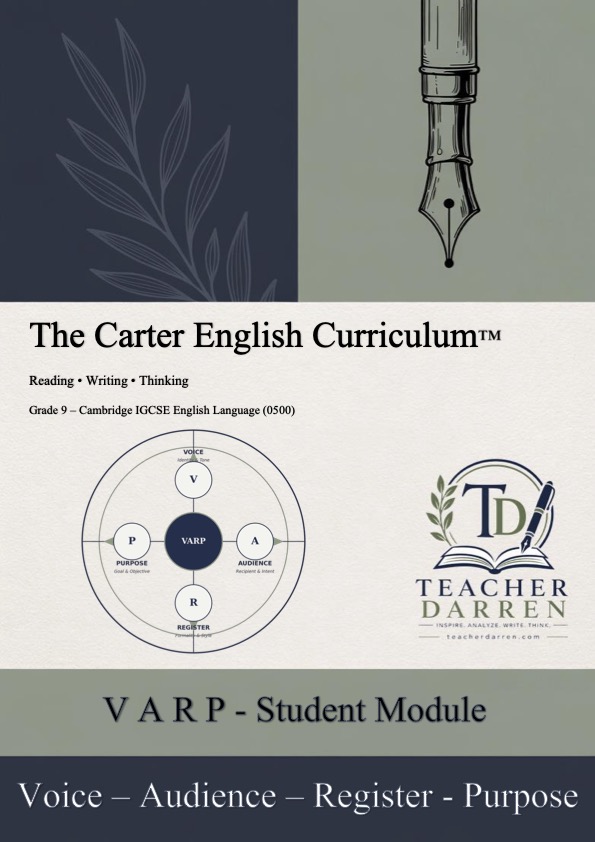
A guided student workbook introducing the complete VARP framework through notebook activities, guided practice, and reflective writing.
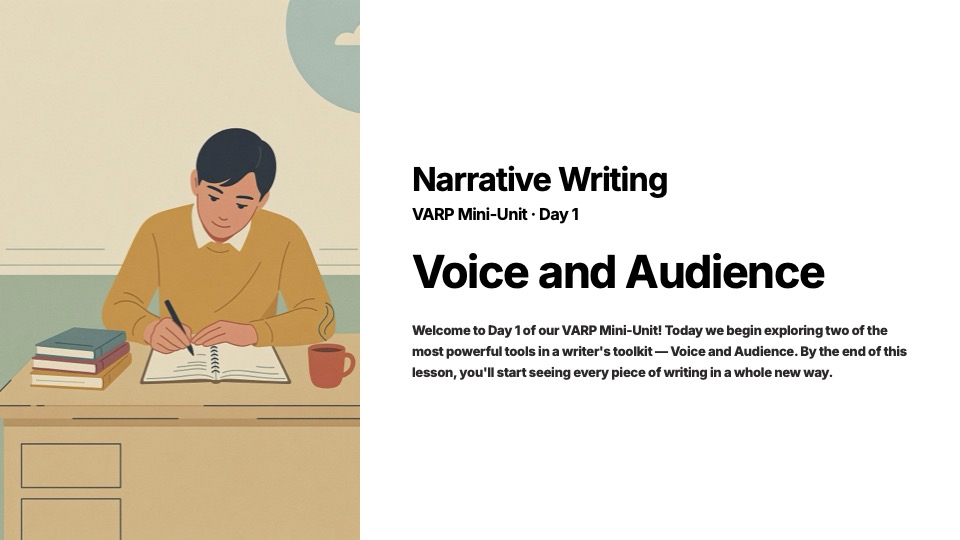
Students explore how an author’s voice and intended audience influence tone, word choice, and meaning through interactive examples and writing activities.
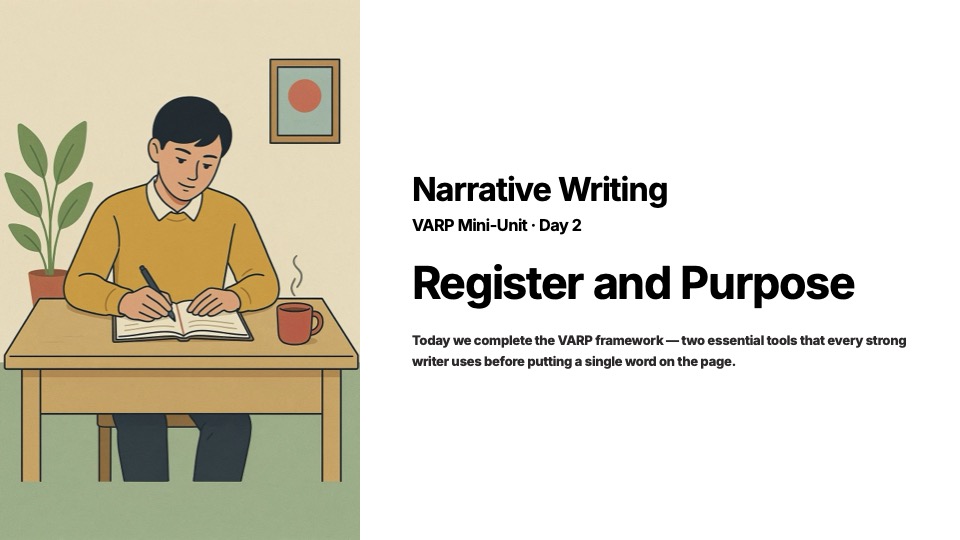
Students complete the VARP framework by examining levels of formality and writing purpose before applying all four elements as a pre-writing strategy.
Varp Mini-unit Documentation
A practical guide explaining the instructional philosophy, lesson sequence, classroom strategies, formative assessment, and Cambridge connections behind the VARP Mini-Unit.
An instructional blueprint mapping the VARP framework across Cambridge IGCSE, IB MYP, and AERO standards while outlining the unit’s pedagogical design and global adaptability.
Narrative Writing: Building a Plot
Every compelling story is built on a carefully crafted sequence of events. In this five-day instructional module, students explore how authors introduce characters, build tension, create turning points, and resolve conflict through the lens of Guy de Maupassant’s The Necklace. Rather than treating Freytag’s Pyramid as a diagram to memorize, students use it as an analytical framework to examine an author’s choices while reading and as a planning tool when preparing to write their own narratives. By the end of the sequence, students understand that effective plots are not accidental—they are intentionally designed to engage readers, develop theme, and create lasting impact.
Mastering Freytag’s Pyramid Instructional Video
This engaging 4-minute instructional video introduces students to the seven stages of Freytag’s Pyramid, explaining how plot develops through the deliberate management of conflict and rising tension. Each stage—from exposition and the inciting incident to the climax, resolution, and denouement—is explored in terms of its purpose within an effective narrative. Rather than presenting plot as a diagram to memorize, the video emphasizes storytelling as an intentional process of designing tension, pacing, and reader engagement.
Designed to complement the classroom lessons, the video provides students with a concise, rewatchable explanation that reinforces key concepts beyond the school day. Whether used for pre-learning, review, or independent study, it supports multiple means of representation by allowing students to revisit the material at their own pace as they develop a deeper understanding of narrative structure and prepare to apply these techniques in their own writing.
Narrative Writing: Building a Plot 5-day Sequence
A complete guided workbook containing reading activities, literary analysis, graphic organizers, reflection tasks, and the plot stage assessment for the five-day instructional sequence.
Introduces the foundations of plot by exploring exposition, character motivation, and the event that launches the story into motion.
Examines how authors build suspense through escalating conflict, character choices, and increasingly complex complications.
Explores the story’s turning point and the immediate consequences that lead readers toward the resolution.
Concludes the story by examining resolution, irony, theme, and how the ending reshapes the reader’s understanding of earlier events.
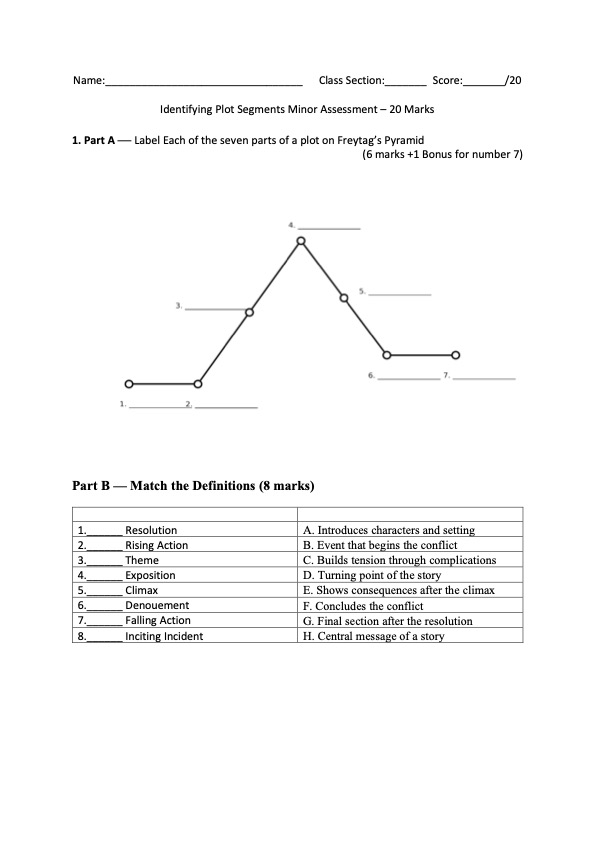
A 20-mark formative assessment measuring students’ understanding of Freytag’s Pyramid, narrative terminology, and the application of plot structure using evidence from The Necklace.
Narrative Writing: Building a Plot Documentation
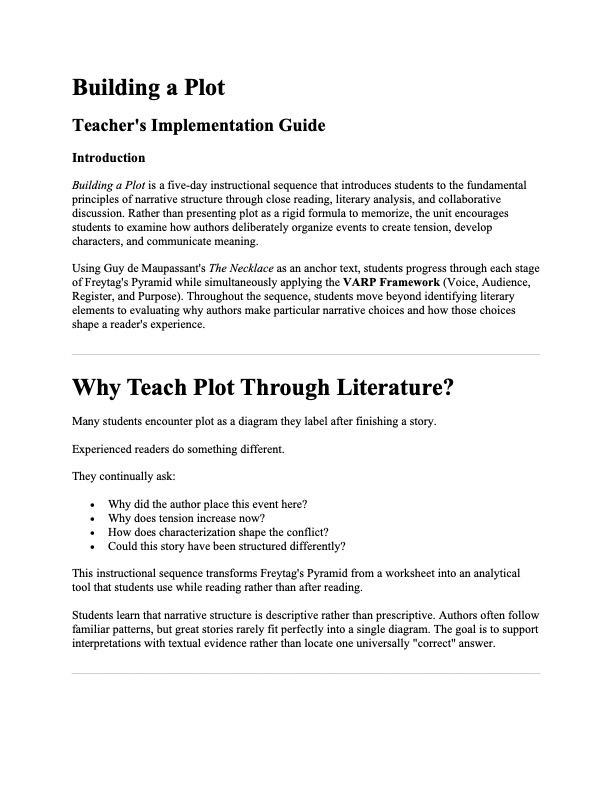
A practical guide explaining the instructional philosophy, lesson sequence, classroom strategies, formative assessment, and Cambridge connections behind the five-day Building a Plot module.
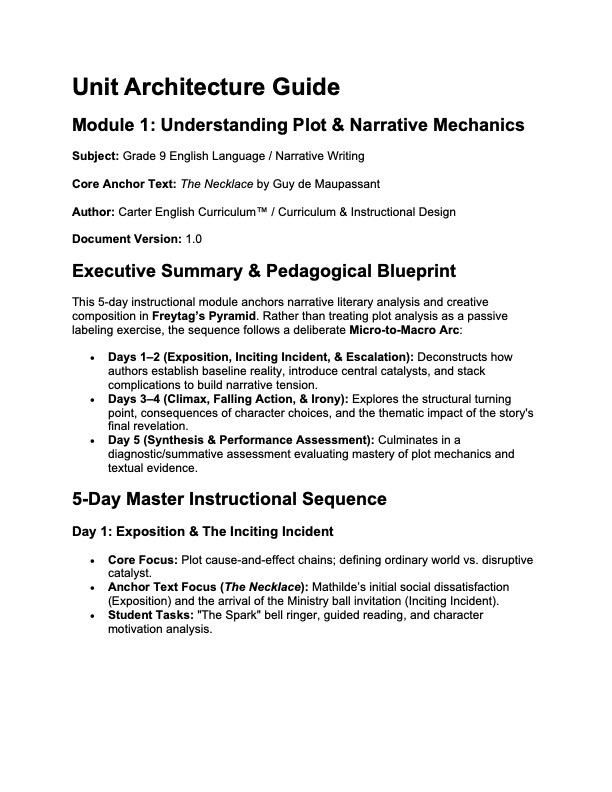
An instructional blueprint outlining the five-day progression, lesson objectives, assessment framework, and pedagogical design behind the Building a Plot sequence.
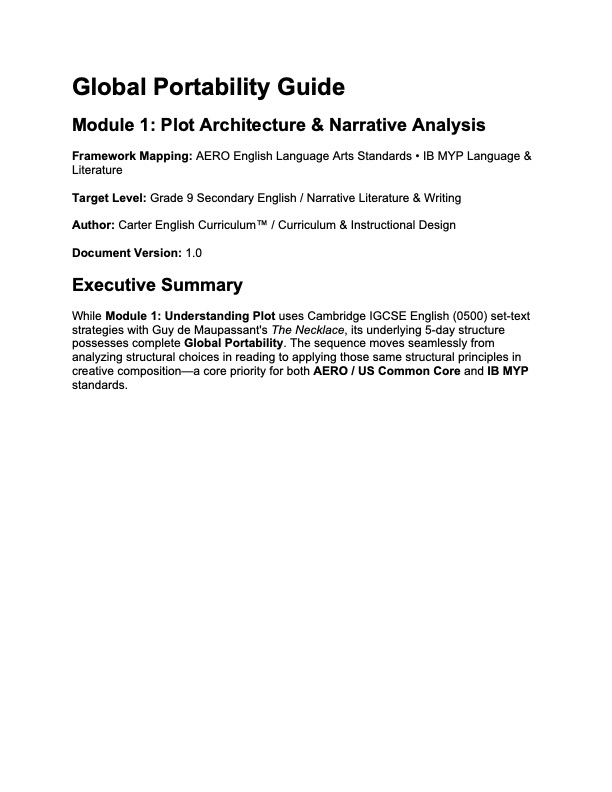
A curriculum alignment guide demonstrating how the Building a Plot module transfers seamlessly across Cambridge IGCSE, IB MYP, and AERO English frameworks.
Narrative Writing is being released as a living curriculum. Additional instructional modules, assessments, teacher guides, and implementation resources will be published as they are completed.