Grammar for Writers
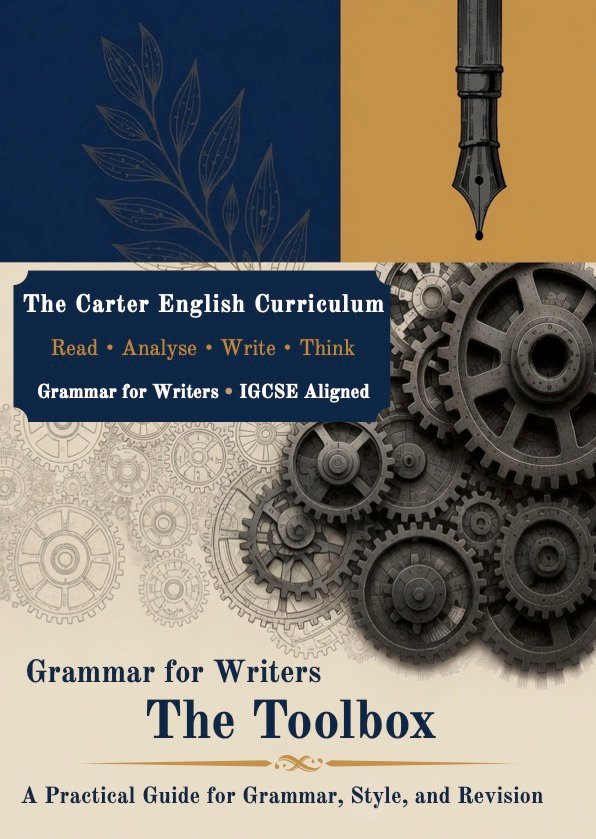
Grammar for Writers: The Toolbox
Grammar for Writers Series
Grammar is not about memorizing rules—it is about making choices.
The Writer’s Toolbox is the cornerstone of the Grammar for Writers series and the flagship grammar resource within The Carter English Curriculum. Designed for secondary English Language Arts classrooms, this comprehensive workbook moves beyond traditional grammar drills to teach grammar as a practical tool for effective writing.
Rather than memorizing isolated rules, students learn how experienced writers make deliberate choices to improve clarity, precision, style, and voice. Through carefully scaffolded lessons, authentic writing tasks, guided revision, and Cambridge-aligned applications, students develop the habits of skilled writers and independent editors. The workbook emphasizes grammar in context, helping learners understand not only what good writers do, but why they do it. Its craft-based approach and consistent lesson architecture distinguish it from traditional grammar texts.
Whether used as a complete classroom curriculum, a homeschool resource, or a supplemental writing program, The Writer’s Toolbox equips students with the skills they need to write with confidence, accuracy, and purpose.
Features
- 20 scaffolded lessons progressing from sentence foundations to sophisticated stylistic control and independent editing.
- Craft-based instruction that teaches grammar as a tool for effective writing rather than isolated rule memorization.
- Authentic writing workshops that emphasize revision, reflection, and purposeful composition.
- Cambridge IGCSE (0500) alignment, with explicit connections to assessment objectives and examination skills throughout.
- Consistent lesson architecture, including Essential Questions, Bellringers, Guided Practice, Writer’s Workshops, Cambridge Connections, and Self-Editing Reflections.
- Universal Design for Learning (UDL) principles embedded throughout to support diverse learners while maintaining rigorous academic expectations.
- Formative assessments, editing protocols, and cumulative performance tasks that build independent writers and self-editors rather than passive rule memorizers.
- Suitable for international schools, homeschool programs, Christian schools, and independent learners seeking a comprehensive secondary grammar curriculum.
Availability
Download Availability: Available by request only.
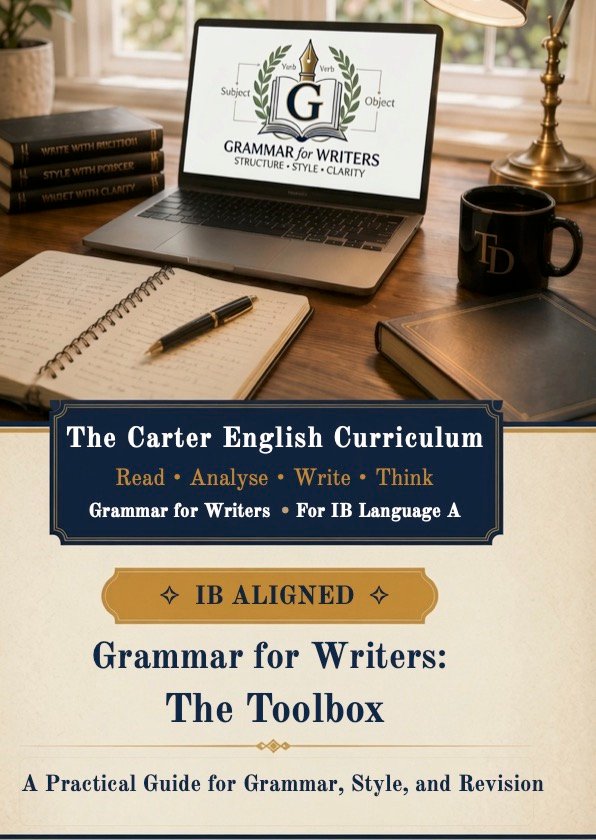
Click the IB Edition image to Download a sample lesson.
The Writer’s Toolbox is currently distributed directly to educators, schools, and homeschool families upon request. This allows me to provide the most current edition, answer implementation questions, gather feedback from teachers, and better understand how the resource is being used in different educational settings. If you are interested in reviewing or implementing the workbook, please contact me through the website. As with all resources in The Carter English Curriculum, my goal is not simply to distribute materials, but to build relationships with educators and support successful classroom implementation.
Currently available in Cambridge IGCSE and IB MYP/DP English A editions. Future editions are planned with comprehensive AERO and AP standards integration.
Disclaimer: This resource has been developed independently by TeacherDarren. It is designed to align with the learning objectives of the Cambridge IGCSE English syllabus, the IB Language A curriculum, or the AERO English Language Arts Standards, depending on the edition. It is not affiliated with, endorsed by, or approved by Cambridge University Press & Assessment, Cambridge International Education, the International Baccalaureate Organization, or AERO.
Grammar for Writers 3 Week Instructional Unit
Curriculum at a Glance
Grade Level: Secondary English Language Arts (Cambridge IGCSE English Language 0500)
Duration: 3 Weeks (15 Lessons)
Assessment: 2 Formative Quizzes • 1 Performance Assessment
Instructional Focus: Grammar • Style • Editing • Composition
Core Skills: Sentence Structure • Punctuation • Revision • Academic Writing
Instructional Resources: Student Workbook • Daily Presentations • Teacher Implementation Guide • Standards Alignment Guide • Formative Assessments
Framework Alignment: Cambridge IGCSE • IB MYP • AERO • UDL Principle
Grammar for Writers is a three-week instructional unit designed for secondary English and Cambridge IGCSE classrooms that transforms grammar from a list of isolated rules into a practical toolkit for effective writing. Rather than treating grammar as an exercise in error correction, students discover how sentence structure, word choice, punctuation, and syntax shape meaning, control pacing, create mood, and influence the reader’s experience.
The unit follows a carefully scaffolded progression. During Week 1, students build a solid understanding of sentence anatomy and learn to diagnose common structural errors. Week 2 shifts from correctness to craftsmanship as students strengthen their writing through precise vocabulary, sentence variety, subject-verb agreement, and verb tense consistency. Finally, Week 3 brings everything together through a structured editorial process in which students revise authentic writing, critically evaluate AI-generated feedback, and demonstrate independent mastery in a final writing assessment.
Every lesson follows the same predictable instructional framework—engaging bellringers, concise direct instruction, hands-on grammar labs, collaborative peer review, and individual exit tickets—to reduce cognitive load while gradually transferring responsibility from teacher to student. Throughout the unit, grammar is consistently connected to Writer’s Effect, helping students understand not only how language works, but why skilled authors make the choices they do.
Designed specifically with Cambridge IGCSE English (0500) in mind, Grammar for Writers develops the technical accuracy, stylistic control, and editorial independence required for success in both directed writing and composition. By the end of the unit, students are no longer simply identifying grammatical errors—they are making deliberate, confident decisions as writers.
Week One: Foundations
Click any image to download the full PDF
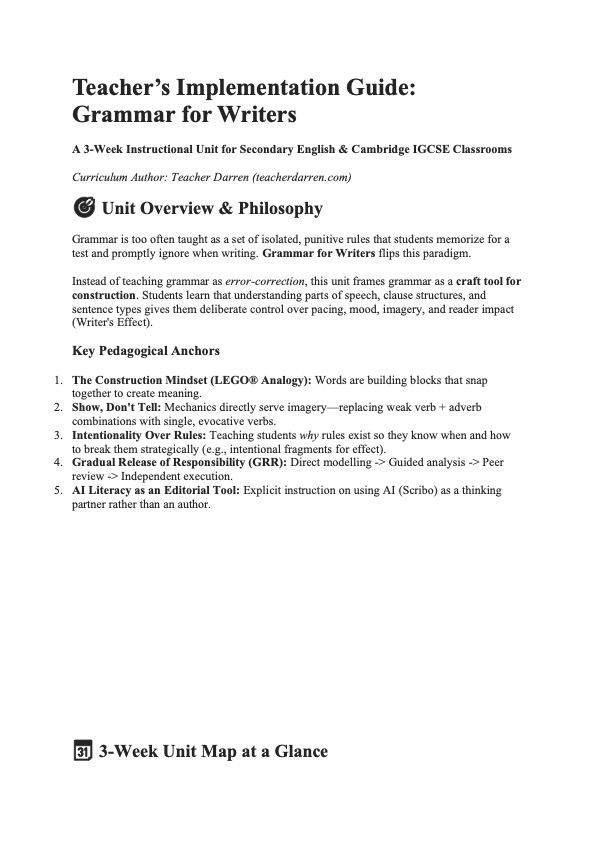
A comprehensive guide explaining the unit philosophy, lesson architecture, technology setup, teaching strategies, and Cambridge IGCSE alignment.
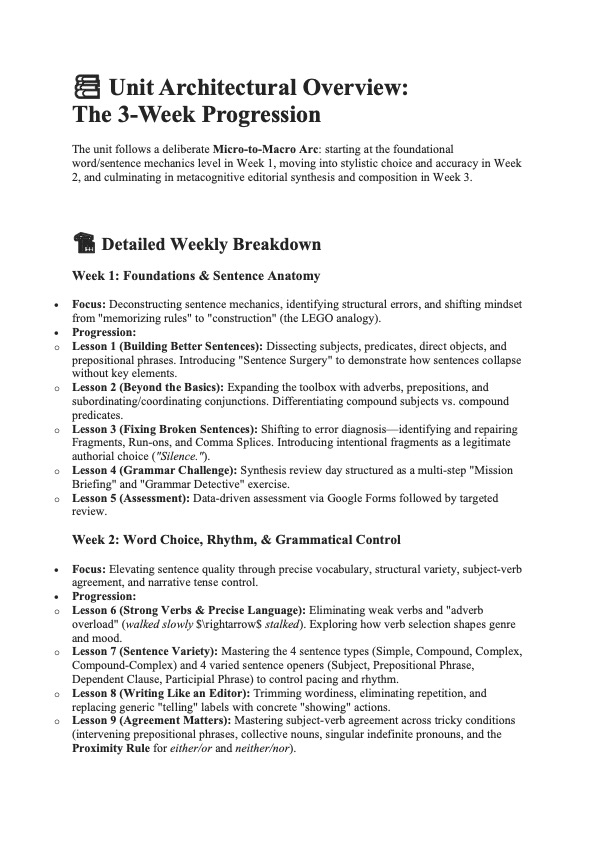
An overview of the unit’s three-week progression, instructional design, scaffolding, and assessment framework.
.
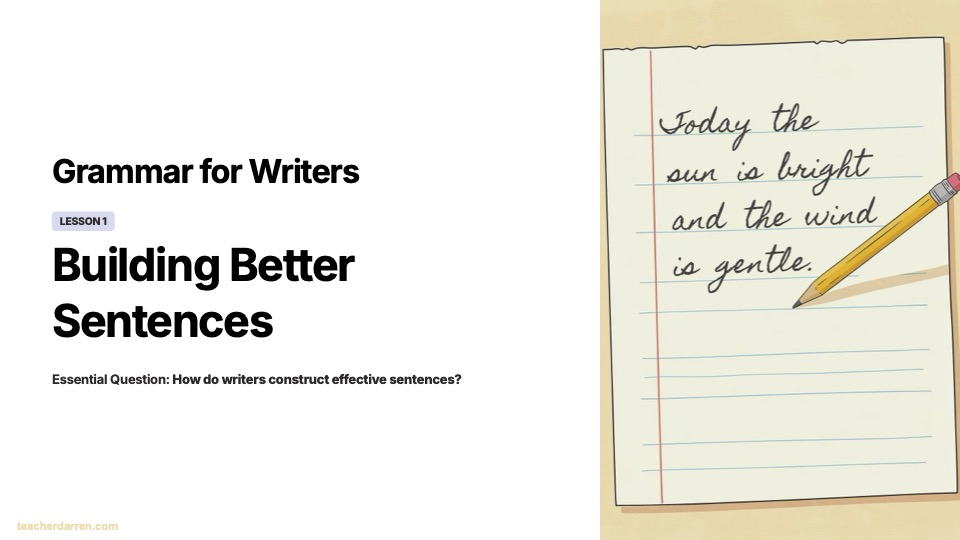
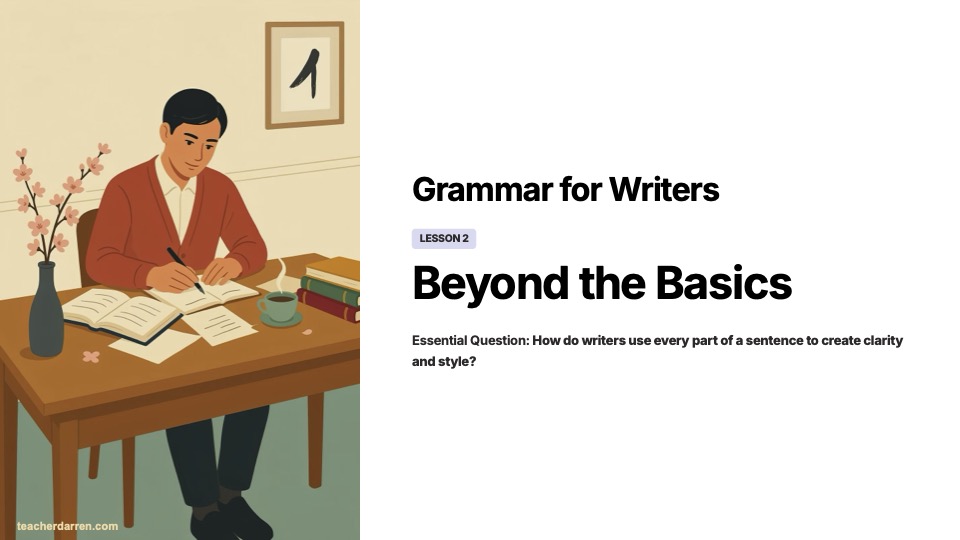
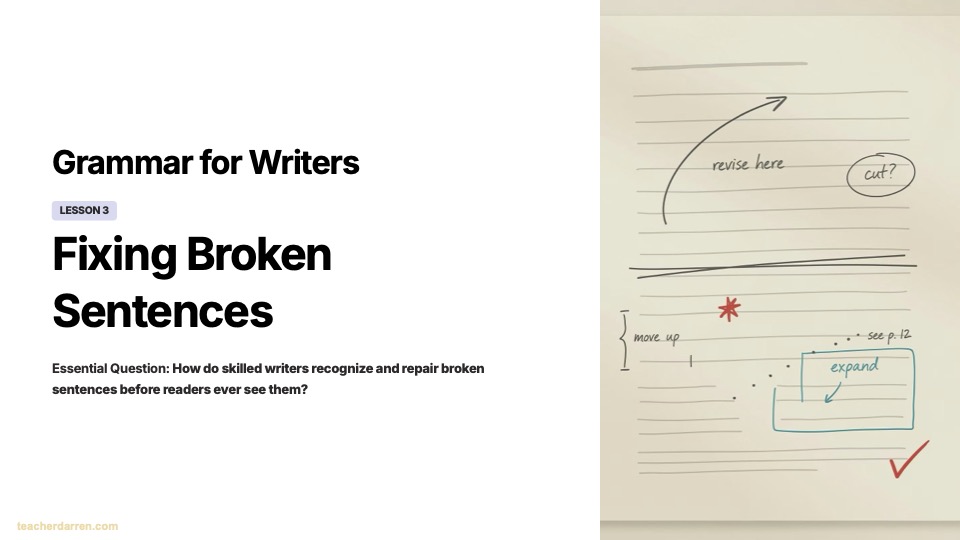
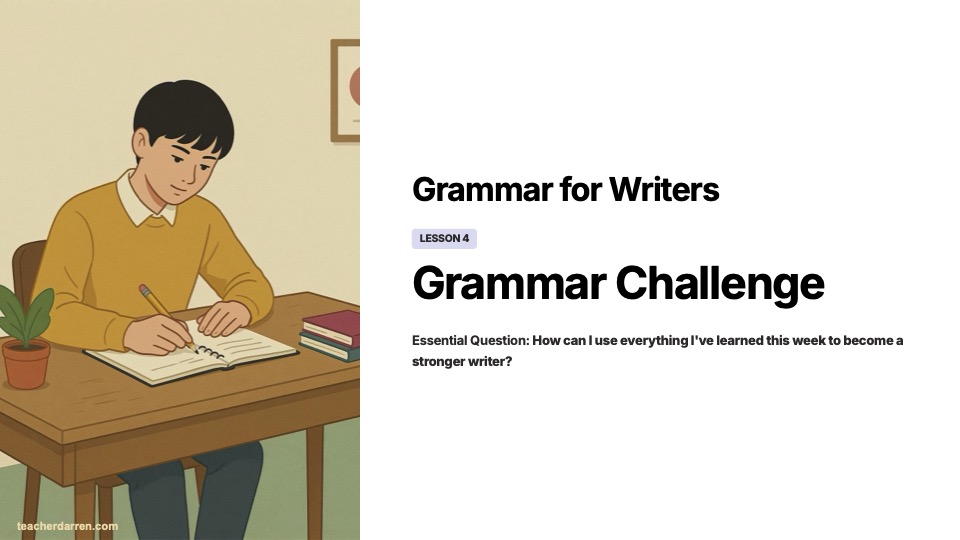
Week 1 – Day 5: Formative Assessment & Data-Driven Review
The final lesson of Week 1 serves as a formative checkpoint designed to measure students’ understanding of the foundational grammar concepts introduced during the week. Rather than moving directly into new material, teachers gather actionable assessment data to identify misconceptions before progressing to Week 2.
The recommended approach is to create a short Google Forms quiz aligned with the week’s learning objectives. Because Google Forms provides instant scoring and item analysis, teachers can immediately identify which concepts—such as sentence anatomy, fragments, run-ons, or comma splices—require additional instruction. The remainder of the lesson can then be devoted to targeted review, allowing teachers to reteach the weakest skills while they are still fresh in students’ minds.
Teachers who prefer a more interactive review may instead create a Kahoot! quiz covering the same concepts. Kahoot transforms the assessment into a high-energy class competition while still providing valuable performance data (with subscription features) that can be used to identify common misconceptions. Whether using Google Forms or Kahoot, the objective remains the same: use formative assessment to drive instruction, ensuring students have mastered the foundations of sentence construction before progressing to more advanced stylistic techniques in Week 2. This data-driven approach supports the unit’s gradual release of responsibility by reinforcing essential skills before students begin applying them more independently.
Week Two: Craft
Click any image to download the full PDF
Friday Formative Assessment: At the conclusion of each instructional week, students should complete a brief electronic formative assessment using Google Forms (or Kahoot!). These assessments are designed to provide immediate feedback to students while allowing the teacher to quickly evaluate comprehension, identify misconceptions, and determine which concepts require additional review before introducing new material. The low-stakes quizzes emphasize mastery and timely intervention rather than summative evaluation.
Week Three: Editing
Click any image to download the full file
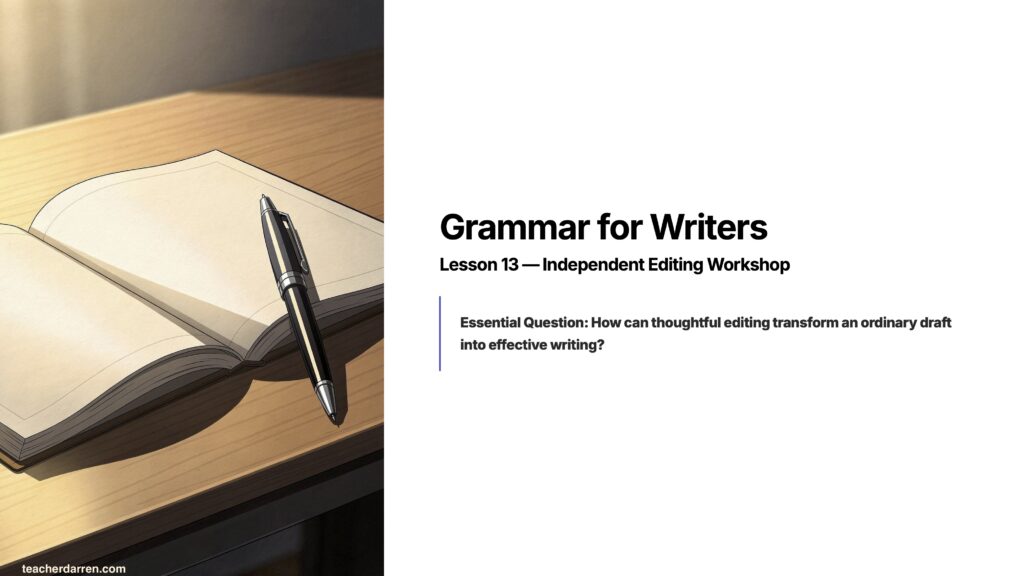
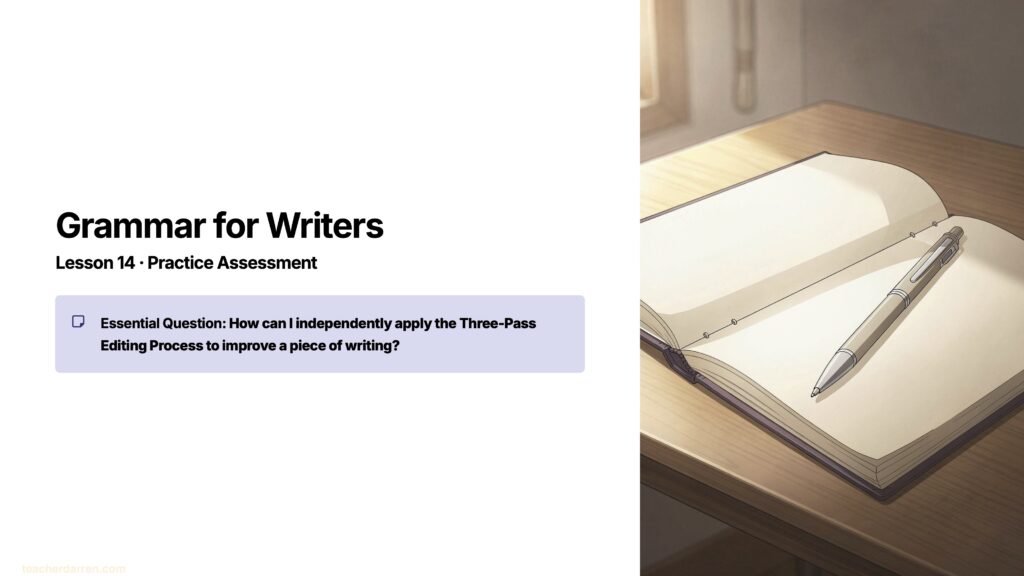
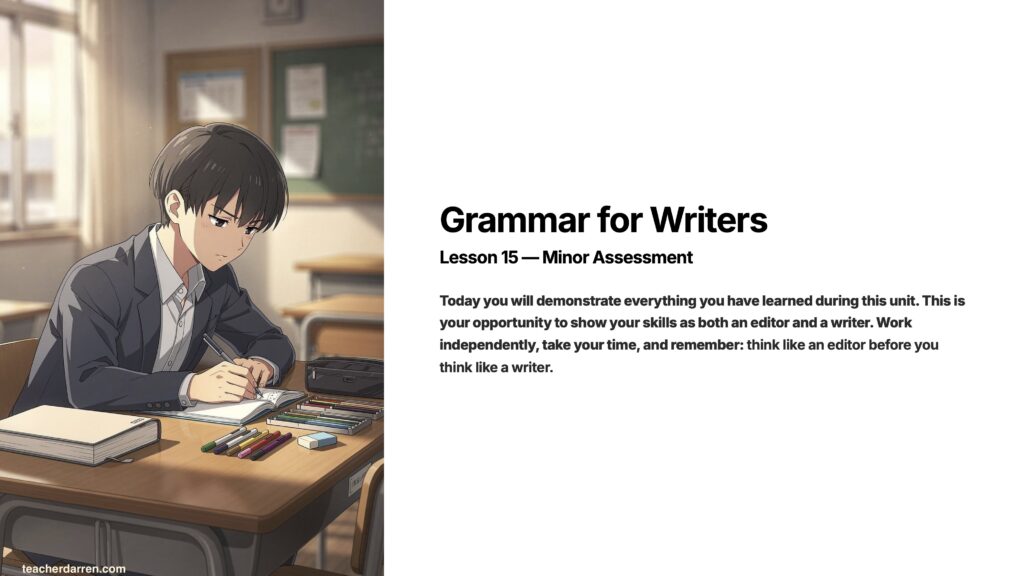
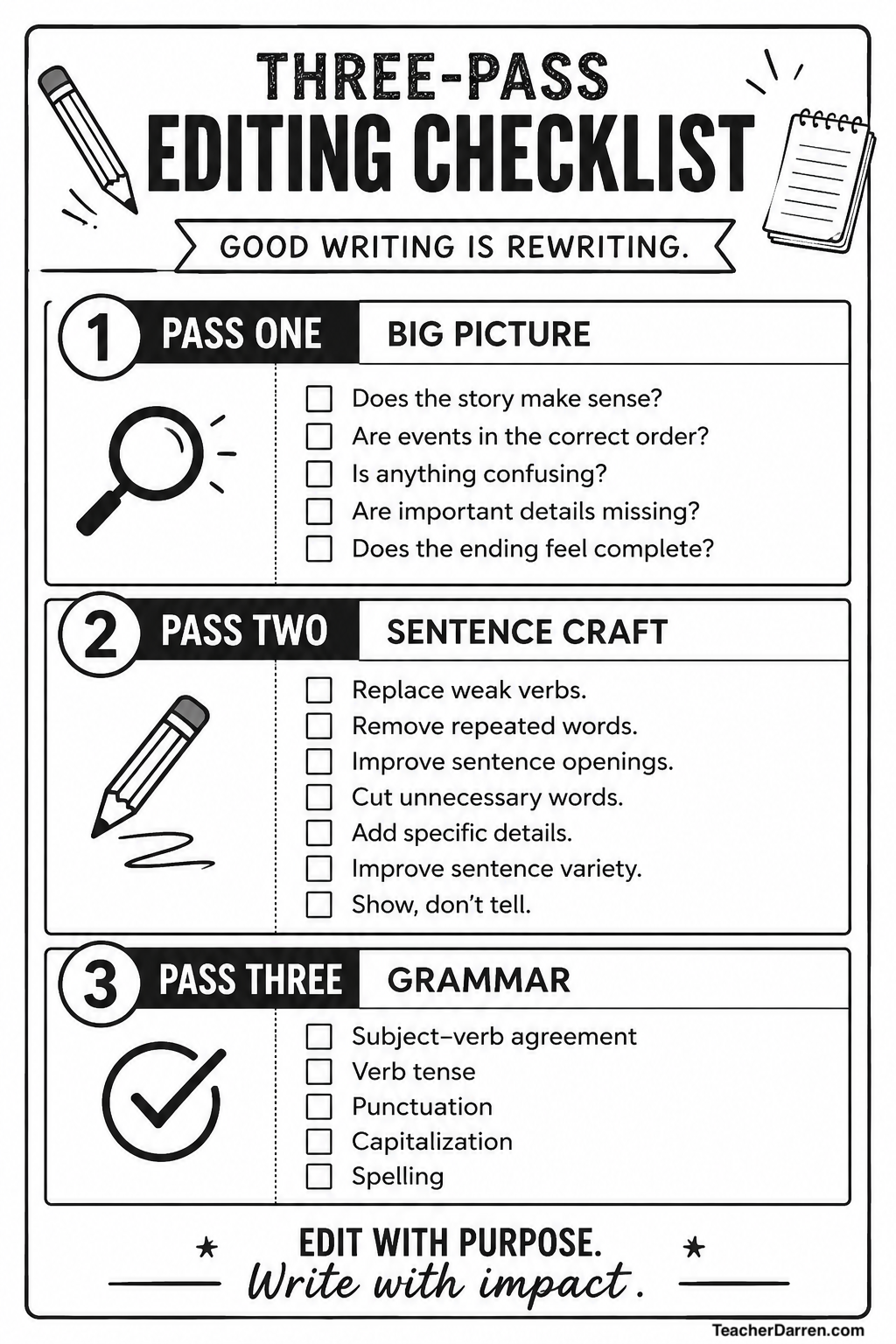
Flexible Assessment & Feedback
The Grammar for Writers unit was designed using Scribo as its primary digital assessment platform because of its ability to provide detailed writing feedback, support structured editing activities, and facilitate the unit’s progressive AI literacy component. During the editorial lessons, students learn to evaluate AI-generated suggestions critically before completing a final independent assessment with AI assistance disabled, reinforcing authentic writing skills and editorial independence.
Although Scribo is featured throughout the instructional materials, it is not required to implement the curriculum successfully. All lessons, activities, and assessments can be completed using Google Docs, Microsoft Word, Google Classroom, other learning management systems, or traditional paper-based assignments. The instructional sequence and learning objectives remain unchanged regardless of the platform used.
The weekly electronic formative assessments are intentionally brief and designed to provide immediate feedback for both students and teachers. Their primary purpose is diagnostic rather than evaluative, allowing teachers to quickly identify misconceptions, monitor student understanding, and determine which concepts require additional review before introducing new content.
The culminating performance assessment is equally flexible. While the included materials demonstrate one implementation using Scribo’s editing environment, the assessment may be administered through any electronic submission platform or as a conventional paper-based writing task. The focus of the assessment is students’ ability to apply grammar, style, editing, and composition skills independently—not the technology used to submit their work.
This flexible design allows teachers to adopt as much or as little technology as their classroom environment supports while preserving the unit’s instructional integrity and pedagogical sequence.
Grammar for Writers was created to help students think like writers rather than rule memorizers. By combining explicit grammar instruction, authentic writing tasks, structured editing, and flexible technology integration, the unit develops the confidence and editorial habits students need for success in Cambridge IGCSE English and beyond.
See It Beyond Cambridge
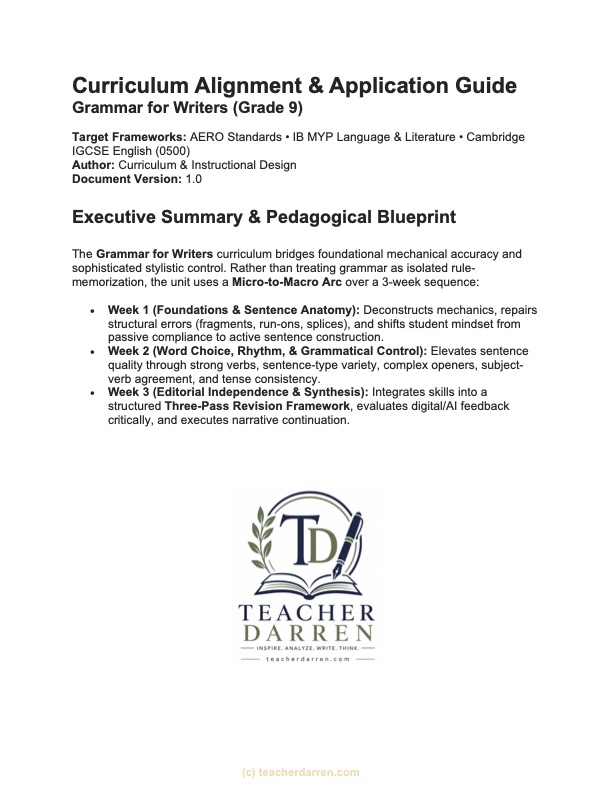
While Grammar for Writers was originally designed for Cambridge IGCSE English (0500), the instructional philosophy extends far beyond a single curriculum. This companion guide demonstrates how the unit aligns with AERO Standards, IB MYP Language & Literature, and Cambridge, illustrating how the same lessons can support diverse international programs without sacrificing rigor or authenticity. The guide includes standards mapping, pedagogical rationale, implementation guidance, and a complete three-week instructional framework, making it easy to see how the unit can be adapted to your own classroom.
Whether you teach in a Cambridge, IB, AERO, or other international curriculum, my hope is that this guide inspires you to adapt, refine, and make Grammar for Writers your own.
Inside you’ll discover:
- Standards alignment across AERO, IB MYP, and Cambridge IGCSE English (0500).
- The pedagogical thinking behind the unit’s three-week progression.
- Practical implementation guidance for secondary English classrooms.
- A complete instructional matrix showing how skills, assessments, and outcomes develop across the unit.
📄 Explore the guide and discover how Grammar for Writers could fit your classroom.
- TeacherDarren is an independent educational publisher.
- Cambridge®, Cambridge IGCSE®, IB®, International Baccalaureate®, and other referenced names are trademarks of their respective owners.
- References are made solely to describe curriculum alignment.
- No affiliation, sponsorship, endorsement, or approval is claimed.